Service
Cracked Tooth
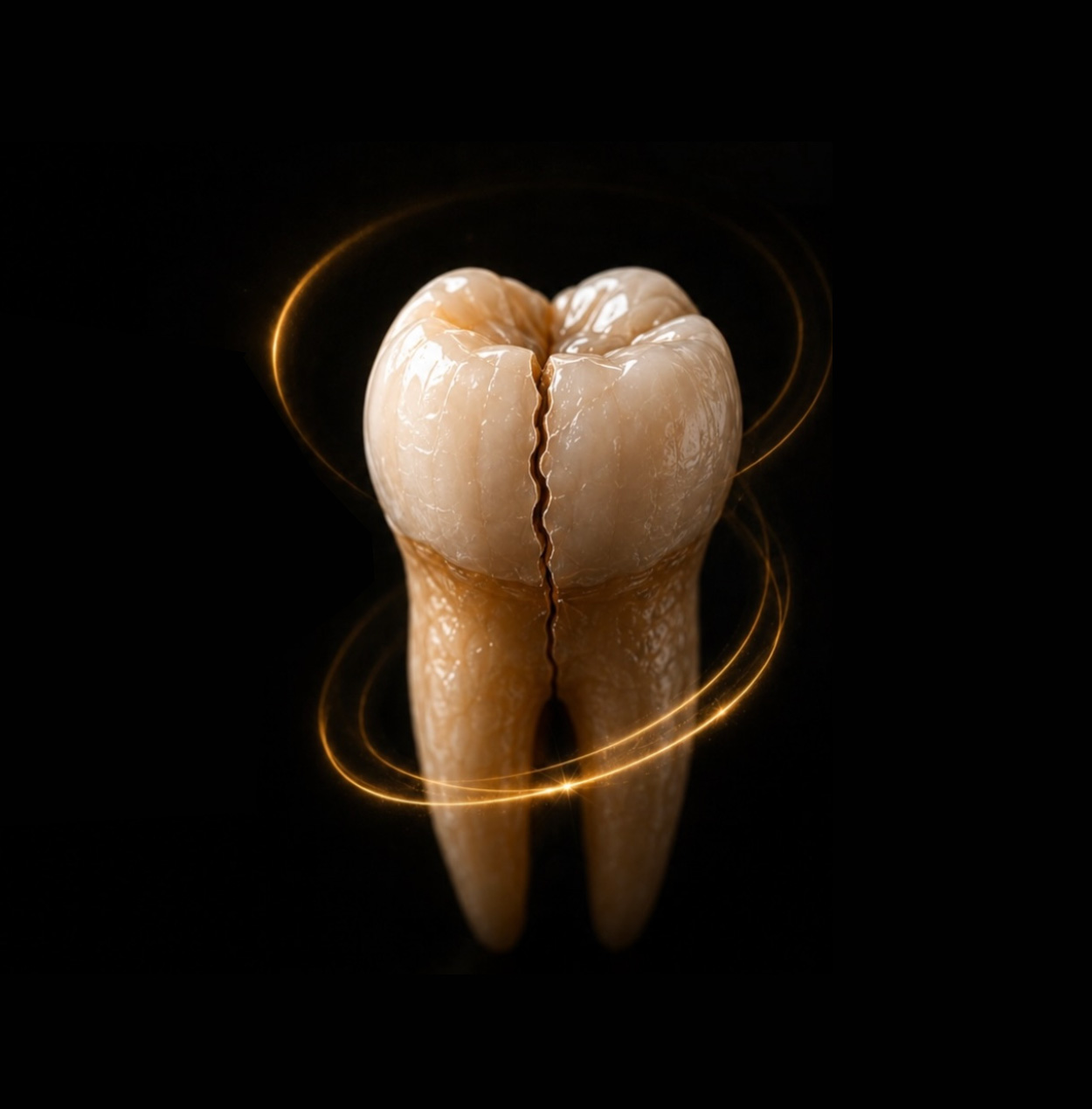
Cracked teeth are a common and often challenging dental problem. A crack is an incomplete fracture that can start on the chewing surface and extend toward or into the root. Unlike a simple chip, these cracks can flex under biting pressure, irritate the pulp (the living tissue inside the tooth), allow bacteria to enter, and produce unpredictable pain. Early, precise diagnosis and the right combination of treatment give the best chance of saving the tooth and restoring comfortable function.
What Is Cracked Tooth?
The American Association of Endodontists classifies cracks into several types. The most relevant for patients seeking specialist care include:
- Craze lines — Superficial cracks limited to the enamel. These are common, usually painless, and rarely need treatment beyond monitoring.
- Fractured cusp — A piece of the chewing surface breaks away, often around an existing filling. The pulp is usually unharmed.
- Cracked tooth — A vertical crack that extends from the chewing surface toward the root. The segments are not yet fully separated, but the crack can deepen over time.
- Split tooth — A more advanced crack that has progressed so the tooth segments can be separated.
- Vertical root fracture — A crack that begins in the root and travels upward; these are often more difficult to manage.
Symptoms commonly include sharp pain on biting (especially on release of pressure), sensitivity to temperature extremes, or intermittent discomfort that is hard to localize. Not every cracked tooth hurts, and the pain pattern can change as the crack progresses or bacteria invade the pulp.
Signs You May Need Cracked Tooth
Cracks develop from a combination of factors that place repeated or sudden stress on the tooth:
- Heavy biting forces, grinding, or clenching (bruxism)
- Chewing hard foods or objects (ice, hard candy, unpopped popcorn kernels, etc.)
- Large or old fillings that weaken the remaining tooth structure
- Trauma or injury
- Age-related changes that reduce the flexibility of dentin
- Thermal cycling and occlusal interferences that create stress points
Once a crack forms, everyday chewing and temperature changes can cause the segments to flex, stimulating nerves or allowing bacterial leakage into the pulp.
The Monempour Difference
Our Approach to Cracked Tooth
Endodontists are specialists in diagnosing and treating problems involving the pulp and the internal structure of the tooth. For cracked teeth we combine advanced diagnostic tools with targeted therapies aimed at relieving pain, stopping bacterial invasion, and stabilizing the tooth.
Advanced CBCT imaging: Traditional two-dimensional X-rays often miss cracks or their associated changes. Cone-beam computed tomography (CBCT) provides a three-dimensional view of the tooth and surrounding bone. It is particularly useful for detecting early patterns of bone loss adjacent to cracks (such as angular defects) and for assessing how far a crack may extend relative to the cementoenamel junction and pulp chamber. CBCT, used together with high-magnification microscopy, improves accuracy in determining whether a tooth is restorable and helps guide treatment decisions.
Root canal treatment when the pulp is involved: When a crack reaches or irritates the pulp, patients often experience lingering pain, spontaneous discomfort, or infection. Root canal therapy removes the inflamed or infected tissue, thoroughly cleans and disinfects the canal system, and seals it. This eliminates the source of pain and infection while preserving the natural tooth. Modern techniques—including the dental operating microscope, conservative canal preparation, and careful placement of internal barriers when indicated—support favorable outcomes when the crack has not progressed too far.
Bonding techniques to stabilize cracks: Adhesive dentistry allows us to bond the cracked segments together. After careful isolation and cleaning (sometimes including disinfection of the crack line), specialized bonding agents and resin materials are used to seal and unite the segments. In selected cases, fiber-reinforced materials can be placed to help bridge and reinforce the crack, reducing flexure and limiting further propagation. These internal bonding approaches work in conjunction with external protection.
Custom coverage restorations to “entomb” the crack: Not every cracked tooth requires root canal treatment. When the pulp remains healthy (or only reversibly inflamed), the priority is often immediate stabilization with a custom full-coverage restoration—typically a crown or onlay. This restoration braces the tooth, distributes biting forces, prevents the crack from opening under load, and protects against bacterial contamination. In many cases this cuspal-coverage restoration alone can resolve symptoms and preserve vitality. When root canal treatment is performed, timely placement of the definitive coverage restoration is still essential for long-term success.
The decision between monitoring, bonding plus coverage, root canal therapy plus coverage, or (in advanced cases) extraction depends on the exact location and depth of the crack, the status of the pulp and surrounding bone, periodontal probing depths, and overall remaining tooth structure. Early evaluation and intervention consistently improve the chances of keeping the tooth.
If you are experiencing biting pain, temperature sensitivity, or have been told you may have a cracked tooth, a focused examination that includes high-magnification inspection and, when appropriate, CBCT imaging can clarify the situation and outline the most conservative path forward. The goal is always to relieve discomfort and save the natural tooth whenever it is predictably possible.
Your Questions Answered
Frequently Asked Questions
We believe that informed patients make the best decisions about their care. Here are answers to common questions about root canal therapy.
Most patients return to normal activities the same day or the next. Some mild soreness is normal and typically resolves within a few days with over-the-counter medication. Dr. Monempour’s team will provide clear aftercare instructions before you leave.
Your general dentist may refer you to an endodontist for complex cases, persistent pain, or when specialized equipment and expertise are needed. As a board-trained endodontist, Dr. Monempour focuses exclusively on diagnosing and treating tooth pain and performing root canal therapy — it's all he does, every day.
You're not alone — and you're in the right place. Our team is experienced in treating anxious patients with patience, clear communication, and a calm environment. We also offer sedation options so you can feel completely at ease throughout your visit.
Yes. We understand that tooth pain doesn't wait, and neither should you. If you're experiencing a dental emergency, call our office and we'll do everything we can to see you the same day.
Your first visit begins with a thorough evaluation, including advanced imaging if needed. Dr. Monempour will take the time to explain your diagnosis clearly, answer all your questions, and outline a treatment plan — with no pressure and no rushing.
Dr. Fred Monempour
Dr. Monempour is a highly experienced endodontist known for his impeccable diagnostic skills, exceptional clinical expertise, and unwavering commitment to patient centered care. He is trusted for performing some of the most complex endodontic cases, combining precision, compassion, and state-of-the-art technology.
What happens after I send my message?
Our front desk will review you information and contact you within 24 hours. If this is an emergency, please call our office.We will accommodate your schedule to set up an appointment in a timely manner.
Address:
433 N Camden Dr
Ste 1100
Beverly Hills, CA 90210
Get Directions